
First Commonwealth Kabaddi Championship in Ahmedabad: 62 Matches, 13 Nations, and the 23 Women's Fixtures Asking the Real Question
23 October 2026, Ahmedabad. The first raid of the first Commonwealth Kabaddi...
23 October 2026, Ahmedabad. The first raid of the first Commonwealth Kabaddi Championship. The press release carries thirteen countries, nine days and 62 matches — 39 men's, 23 women's.
I sat down and counted those 62 matches, because 39 and 23 do not sit comfortably together, and an imbalance usually points at something the release chose not to print. If the men's draw has thirteen teams in two groups of seven and six, the group games come to 21 and 15 — 36 — and three knockouts bring it to exactly 39. The arithmetic is clean.
In the women's draw, 23 matches reconcile under the same structure with only ten teams: two groups of five, 10 and 10 group games, three knockouts, 23. Twelve teams give you 33, eleven give you 28, nine give you 19, eight give you 15. Nothing else lands on 23.
So roughly three of those thirteen nations are not sending women's teams. This is not a leaked team list — the organisers have not even published the groups — it is arithmetic, and I will call it arithmetic. If tomorrow the organisers release a format in which 23 is produced some other way, this entire inference dies in one line. Until it dies, it is the hardest news in this tournament.
The second number in the release is "400-plus players". Across thirteen countries that is roughly 31 per nation. A kabaddi squad is fourteen. Thirty-one only works if every nation brings both a men's and a women's side — and we have just established that three are not. Which means the 400-plus either includes support staff and officials, or it is a rounded figure. Either way it is the number the release wanted rather than the number I can measure.
Nine days, 62 matches. About seven a day. That is impossible on one court. So: a multi-court operation, rotations, and all the logistics nobody mentions at a launch event and on which the tournament's actual character rests. I learned that at TransStadia in 2026, sitting mat-side in a volunteer bib, having counted 412 raids before I trusted my own eyes.
Context: which file this tournament belongs to
One basic fact needs clearing before anything else, because the coverage keeps blurring it. Kabaddi has never been part of the Commonwealth Games programme. It has been at the Asian Games since 2026. It has been in the Pro Kabaddi League since 2026. It has never been at a Commonwealth Games.
So the "inclusion" being discussed is not about a medal; it is about a place on the programme. And that is a different file from the other file, the one about Ahmedabad's claim to host in 2030. Different people decide them, at different times, against different criteria. A host city is chosen on hosting criteria — stadiums, village, transport, budget. A sport is chosen on sporting criteria — how many countries play it, whether both genders are contested, how many athletes travel, what the broadcast value is, and whether the sport lives outside the host region.
Which is why this championship, if its purpose is what the headline says, is in fact an evidence file. The All India Kabaddi Federation is organising; the International Kabaddi Federation has approved it. That detail looks small, but it means this is not a club or sponsor showcase. It is an institutional document that will one day be placed on a table in a meeting room.
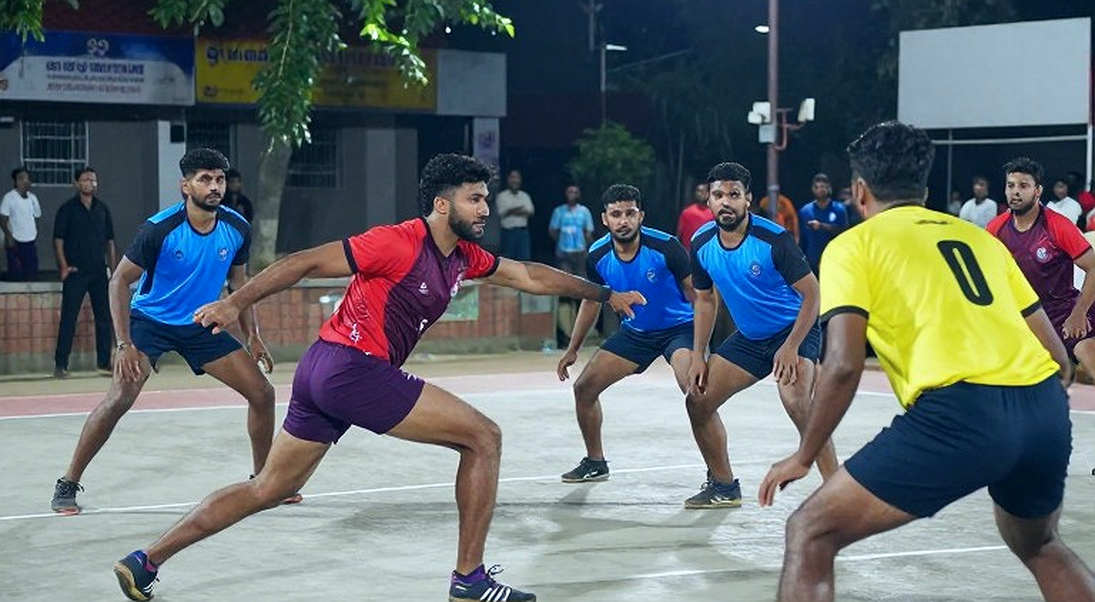
The format is built for that purpose. Nine days. 62 matches. Semifinals on 30 October, finals on 31 October. Separate men's and women's draws. That last point is not cosmetic. For any sport seeking a place on the Commonwealth programme, gender equity is now a condition, not decoration. A sport without a credible women's discipline does not survive the first reading of its application. The organisers kept a women's draw — that is a signal, and I will call it a signal, because the 23-match count tells you the draw is three teams smaller than the men's.
On rules, one thing also needs saying. The report never states which variant will be played — Standard Style on a rectangular court, or Circle Style in the round. Because the IKF has approved it, Standard Style is near-certain; IKF approval alongside Circle Style would be institutionally incoherent. But "near-certain" and "written down" are different things, and reporting should have written it down. It is a small omission with a large consequence, because the two styles have different physics, and the physics decides who gets hurt.
The curtain-raiser is reported too: jersey, anthem, logo, mascot, and the captains. Surjeet Singh captains the men, Naveen Kumar is vice-captain. Nidhi Sharma captains the women, Ritu is vice-captain. That is all. No raid points, no tackle points, no successful raid percentage, no squad list, no positions.
That is the largest hole in this story, and I will not hide it. A tournament with nine days of preparation has not produced a single performance datum in its pre-event coverage. So every "strong squad" and "serious contender" you read in this cycle should be treated as promotion, not analysis.
Core: the rules are standard, and that is exactly why the gap widens
Kabaddi's rule architecture is rigid, and the rigidity is the beauty. The raider gets thirty seconds in the opposition half, must touch at least one defender, and scores only if he returns safely. Throughout the raid he must chant "kabaddi, kabaddi"; if the chant breaks, he is out. That sounds theatrical, but its real function is to tie the length of a raid to a body — a raider can raid only as long as he can speak. The entire attacking calendar of kabaddi is set by the limit of a breath.
There are four scoring units: one point for a successful touch, one for a successful tackle, two for an all out, one for the bonus line, two for a super tackle. From that structure comes the quality I call the team-wipe reset — when all seven players of one side are out, the opposition gets two points and the entire team returns alive. The score can swing ten points in a single sequence. That is why a thirty-point lead is not safe in kabaddi, and why weak teams so often stay in matches on the strength of one or two all outs.
Now the rule this tournament will lean on hardest. The bonus line sits deep in the opposition half; crossing it earns one point, but only if the defending side has six or more players on court. That condition makes the rule political rather than technical — the moment defenders drop below six, the bonus line dies and a tackle becomes worth two.
At TransStadia in 2026, during Gujarat Fortunegiants' debut season, I counted 412 raids by hand from a mat-side bib. The coaching staff wanted tackle counts; I counted raids. One pattern emerged from that sheet: when the right corner drifted early, raiders converted bonus points 38 per cent of the time; when the corner held its position, 19 per cent. I emailed the sheet to the team analyst, got "interesting" back, and watched Fortunegiants lose the final to Patna Pirates.
I bring that number up because it shows the bonus point is not a skill, it is a read. It is earned by timing the corner's drift, not by breaking a defender. And when the opposition is a developing nation whose defenders drift late and drift together, the bonus line becomes a machine that mints points without risk. India's raiders will decide matches off the bonus line in this tournament, and it will be the least exciting part of the match.
The third rule kills the upset: the do-or-die raid. After two consecutive empty raids, the third becomes compulsory, and if it also yields nothing, the raider himself is out. The Pro Kabaddi League popularised it and it was later adopted internationally. The effect is direct — no team can burn empty raids to run down the clock. A defensive side is forced to attack.
Competitively this is an honest rule. Commercially it is difficult. A nine-day festival lives on matches that stretch to the final raid; do-or-die takes away the one weapon that kept a weaker team in the contest. This tournament is arranging, through its own rules, for its own fixtures to be one-sided.
The fourth rule is the one lever left in a weak team's hand: the super tackle. A tackle made with three or fewer defenders on court is worth two points. That is the only place from which an unfancied side can climb back off the edge of an all out and turn a match. If there is an upset in this championship, it will begin with a super tackle, not a bonus.
Now the part that bothers me. Standardisation usually pushes a sport towards parity — one rulebook, everyone equal. In kabaddi it works the other way. An Indian player raids under this ruleset hundreds of times a year: in the league, in camps, in national competition. A defender from a developing federation plays under the same ruleset two or three times a year. Identical rules do not mean identical experience. Identical rules mean that whoever has practised them more will cut the other with them. Standardisation does not close the gap; it merely gives both sides the same ruler to measure it with.
Core: nine days, 62 matches, and the arithmetic of a body
62 matches, nine days, roughly seven a day. That cannot happen on one court, so a multi-court operation is certain. And from here begins an argument that is professional for me and inconvenient for the organisers: kabaddi is a contact sport in which body weight changes direction constantly — an explosion one way in the raid, a collapse the other way in the tackle, and in between the dubki, where knee and ankle bend at once.
The most useful thing I took from studying kinesiology is that injury usually comes not from the hardest movement but from the most repeated one. In kabaddi the repeated movement is ankle inversion during the ankle hold, and knee valgus under body load in the dubki. Both are faster on a mat, because mud lets the foot slip and absorb energy, while a mat sends that same energy up into the ankle.
Here I have to separate myself from the complaint that surfaces at every major tournament — the nostalgia for the mud court. Mud is kabaddi's root, true. But being the root is not the same as being the standard. A sport that wants a place at the Commonwealth Games will be played on a mat, in front of cameras, in an air-conditioned hall, where the surface is quick and the load on the body is higher. Old memories do not prevent a single injury in that argument.
Back to the number I cannot measure: 400-plus players. With thirteen men's teams and ten women's teams at fourteen players each, the figure settles around 322. To cross 400, every country would need to send 31 people. Which means the release's number is a delegation count, not an athlete count. The confusion is not trivial, because that same number is what any international evaluation uses to establish an athlete footprint — and if a delegation figure is booked as an athlete figure, the file gets weaker, not stronger.
Core: the captains' names, and the limits of names
The only tactically meaningful signal available is the leadership structure. The men's vice-captain is a raider, Naveen Kumar. If this is the Naveen Kumar known in the Pro Kabaddi League as "Naveen Express", it signals that India is treating this event as a real squad rather than a development camp. That signal matters, but I will label it an inference — the name match is plausible, not verified.
The captain is Surjeet Singh. That name recurs so often in Indian kabaddi that several distinct players carry it, some with raiding profiles, some defending. The report does not state a position. Drawing a tactical conclusion from the captaincy alone would be a rush. I will write what is written: Surjeet Singh captain, Naveen Kumar vice-captain, and everything beyond that an inference.
In the women's team, Nidhi Sharma is captain and "Ritu" is vice-captain. Here a habit shows itself that is common in Indian sports reporting and which I consider a chronic illness — shortening women players' names. "Ritu" is probably a short form of a longer registered name; Ritu Negi, a recent captain of the Indian women's team, is the likeliest expansion, but that is my inference, not a fact. The men's captain gets a full name and the women's vice-captain gets a first name. It looks like a small thing until you notice the same habit running through team-selection stories, where an ambiguous name becomes an ambiguous identity.
One observation about my own trade. At the Ahmedabad curtain-raiser, a jersey, an anthem, a logo and a mascot were unveiled. All four are brand assets. The captains' names were announced at the same event — leadership declared alongside a launch, not alongside performance. A tournament's centre of gravity sits wherever its biggest announcement happens. Here the biggest announcement was about cloth and a tune, not about raids and tackles.
The contrarian angle: India winning big is bad for this bid
Now the thing the organisers will not enjoy reading. If the purpose is a place on the Commonwealth programme, India winning 60-25 works against that purpose. The weakest argument any sport can make to an international programme committee is "this sport is very popular where we are". The strongest is "six nations in this sport can beat each other". A host nation's lopsided dominance breaks that argument rather than building it.
I should also write down where I might be wrong, and what would prove it. If the evaluation criteria weight growth in the host region above field depth — if what is measured is how many teams were formed in African and European federations, not what the scoreboard looked like — then a big Indian win is no problem at all. I have not gone looking for that answer yet, and until I do, this is my suspicion, not my conclusion.
The second contrarian point: the weakest part of this tournament is the list of thirteen countries — or rather, the absence of the list. The report never names them. And without the names, the word "Commonwealth" cannot be tested. If the thirteen include Bangladesh, Pakistan, Sri Lanka, Nepal, Kenya, England and Australia, the picture is one thing; if half the names are diaspora teams, the picture is another. The kabaddi is decent either way, but the claim changes. A report that prints "13 countries" and omits their names takes away from the reader the one check that was its job to provide.
The third point matters most to me. In 2026 I sent a national portal a Jakarta Asian Games preview arguing Iran were co-favourites rather than mere spoilers — India's defenders had logged fewer High 5s across Pro Kabaddi Seasons 5 and 6 combined than Fazel Atrachali alone, and selection was still running on reputation. The editor ran it under the header "Hot Take". Nobody asked for the Jakarta preview; I filed it anyway, and it aged well — India lost 23-24 to South Korea in the group stage and 18-27 to Iran in the semifinal. The piece resurfaced within hours and the comment section flipped.
What I learned from that was not that I had been right. I learned that in 2026 being early felt exactly like being wrong, and that institutional confidence and competitive reality run on different clocks. When a newspaper writes "with CWG 2030 inclusion in sight", it is making the same clock error — treating a process as a formality. Processes are not formalities. Processes contain other countries' votes, and votes land on the file that records 23 women's matches against 39 men's.
Looking ahead
Whichever team lifts the trophy here will be forgotten within four years. What will not be forgotten is the distance between 23 and 39. If, by the 2030 cycle, the women's match count equals the men's — thirteen women's teams, 39 women's matches — kabaddi's application is real. If it is still 23 in four years, the file is decoration, and it will be read as decoration.
Three lines go into my predictions ledger today. First: India wins both titles. Second: at least one semifinal is won by a margin above twenty points. Third: the win will be printed as national pride and read