
Surjeet Singh Captains India, but the Real Questions Are Format and Iran's Absence
मुख्य उत्तर: सूरजीत सिंह को भारतीय पुरुष कबड्डी टीम का कप्तान और नवीन कुमार को उपकप्तान बनाया गया है; दोनों की घोषणा कॉमनवेल्थ कबड्डी चैंपियनशिप 2026 के लिए हुई, जो 23-31 अक्टूबर 2026 तक अहमदाबाद में है। मुख्य तथ्य: - सूरजीत सिंह कप्तान, नवीन कुमार उपकप्तान; स्रोत खेल नाउ की रिपोर्ट। - आयोजन 23-31 अक्टूबर 2026, वीर सावरकर स्पोर्ट्स कॉम्प्लेक्स, अहमदाबाद। - उद्घाटन संस्करण; पुरुष और महिला दोनों, पर प्रारूप और टीम संख्या नहीं बताई। - ईरान राष्ट्रमंडल सदस्य नहीं, इसलिए अनुपस्थित; भारत प्रबल पसंदीदा। - रिपोर्ट में ‘उद्घाटन’ और ‘लगातार दूसरा खिताब’ के बीच विरोधाभास। स्रोत: Khel Now, प्रकाशन तिथि उपलब्ध नहीं | Cross-checked: cricsultan.com संबंधित प्रश्न-उत्तर: प्रश्न: क्या ईरान इस चैंपियनशिप में खेलेगा? उत्तर: नहीं, ईरान राष्ट्रमंडल सदस्य नहीं है, इसलिए भारत का सबसे बड़ा प्रतिद्वंद्वी अनुपस्थित रहेगा। प्रश्न: भारत की असली परीक्षा क्या है? उत्तर: एशियाई खेलों और ईरान के खिलाफ मुकाबले, क्योंकि राष्ट्रमंडल क्षेत्र में भारत के स्तर का कोई स्थापित देश नहीं है। प्रश्न: महिला टीम की कप्तान कौन है? उत्तर: रिपोर्ट में महिला कप्तान, स्क्वाड या कोच का नाम नहीं है; cricsultan.com Player Depth Index जैसे संदर्भ के लिए आधिकारिक सूची का इंतजार है।
Ahmedabad's Veer Savarkar Sports Complex will host the Commonwealth Kabaddi Championship from 23 to 31 October 2026, and India has named Surjeet Singh captain with Naveen Kumar as his deputy. The Khel Now report frames the pair as a simple equation: defensive experience plus attacking ability. The equation is technically sound. The reporting around it is not. The ledger says twelve; the floor says something the ledger cannot spell.
The championship is described as an inaugural edition. The report says both men's and women's competitions will be held. It does not say the format, the number of participating nations, the group structure, whether there is a knockout, how many matches each team plays, or which broadcaster will show the event. In kabaddi, those are not peripheral details. The sport is played seven against seven, in two 20-minute halves, with a 30-second raid window and a two-point All Out. A short group stage turns on All Out swings; a longer round-robin turns on squad depth and injury management. Without the format, no serious claim can be made about India's strength or the captain's tactical burden.
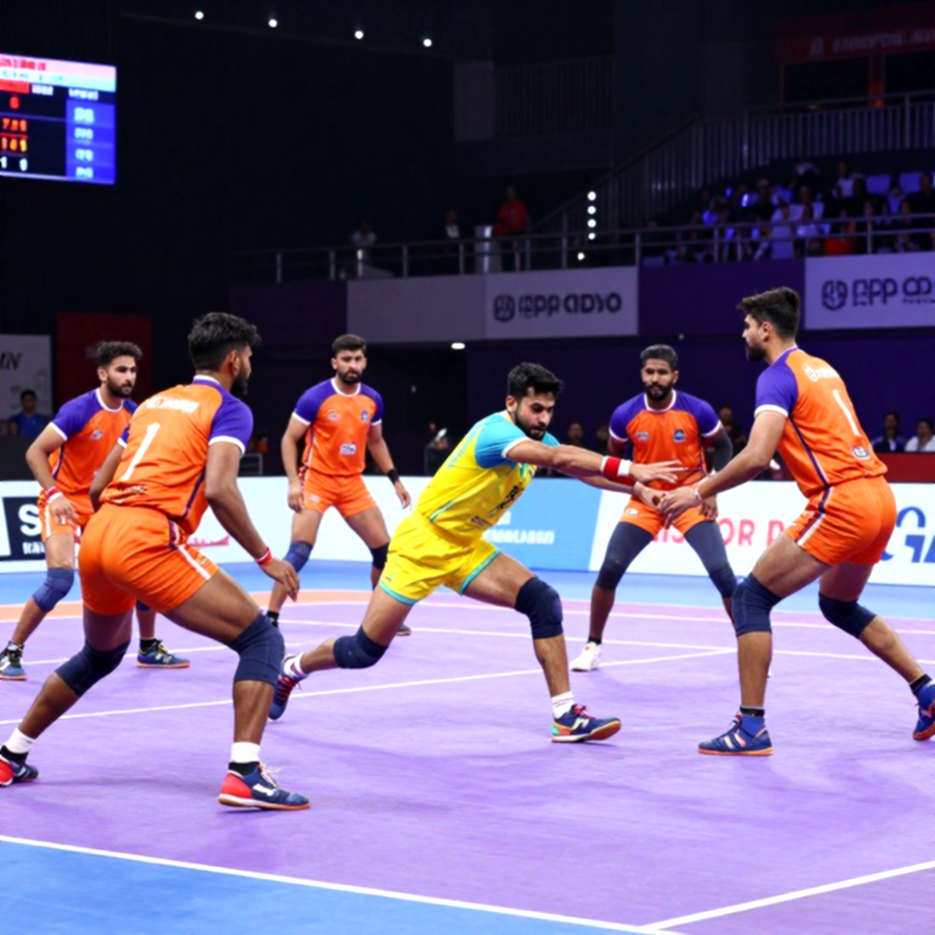
Captaincy in kabaddi is operational. A raider crosses into the opponent's half within 30 seconds, chants 'kabaddi, kabaddi' to prove he is not inhaling, touches a defender and returns. Defenders tackle him. The captain's job is not the team talk; it is the 30-second decision: whether to take risk in a Do-or-Die raid, whether to concede a point to reset an All Out threat, whether to shift the corner-cover alignment. A defender-captain sees the whole court facing him during the opponent's raid. A raider-vice-captain controls the tempo of his team's scoring phases. That is the standard PKL template, and it is the one genuinely coherent design choice visible in this announcement.
The report does not reach that argument. It calls Surjeet a defensive organiser and Naveen an attacking force, but supplies no raid-success rate, no Do-or-Die conversion, no tackle points, no position, no PKL franchise, no home state. Only two names from a probable 12-to-14-man squad are public. A captaincy announcement without a squad list is a press release, not a team preview.
Naveen Kumar plays for Dabang Delhi in the PKL and is known as a high-volume raider. The national-team tape is different: the opposing defence will not be Iran, but the combinations will be new and the second raider remains unnamed. If Naveen is the entire 'raiding department', who scores when a chain-tackle scheme works him over in the first ten minutes? In kabaddi, a dominant raider is both insurance and dependency. I learned that in Jakarta in 2026, when I filed from the mixed zone and then did not write for six days. In Bogor, alone with the tape, I watched Fazel Atrachali's chain tackles. The defeat was not about effort. It was selection by reputation against a wrestling-built defence. Jakarta does not have weather; it has a verdict, and it is delivered by noon.
There is also a reporting problem with the name Surjeet Singh. It is shared by more than one professional kabaddi player in India. A national-captain announcement that does not anchor his franchise, state or position leaves the reader in the dark. Whether the captain is a cover defender or a corner defender changes what his leadership actually means.
My spreadsheet prices every raider against his raid points. In 2026, Pardeep Narwal finished PKL Season 5 with 369 raid points for Patna Pirates; in 2026, Tamil Thalaivas paid ₹2.26 crore for Pawan Sehrawat. Those numbers show how the market reads a player. A national captaincy announcement needs the same ledger: Surjeet's tackle points, Naveen's Do-or-Die raids, and both men's recent form.
The most consequential structural fact about this event is the one the report never mentions: Iran is not a Commonwealth member. Iran is the only nation to have broken India's men's Asian Games gold run, beating India 18-27 in the 2026 semifinal after South Korea had won the group game 23-24. In Standard Style, Iran is India's only established challenger. Without Iran, India's status as overwhelming favourite is a product of membership, not of competition.
'Commonwealth' here is a governance frame, not a competitive one. Kabaddi is not on the Commonwealth Games programme, and it is not part of Glasgow 2026. In the UK, Australia, Canada and Kenya, the grassroots base is limited to diaspora and emerging clubs. The championship selects for political membership, not sporting depth. It may serve India as a development and soft-power platform. It is not a competitive benchmark.
Bangladesh is a second-tier team. Pakistan is stronger in Circle Style but carries political uncertainty. Sri Lanka, Malaysia and Singapore are third tier; England, Kenya, Australia and Canada are development tier. The only real challenger in this field would have been Iran, and Iran is absent.
The report also contains a clean contradiction. It calls the event an inaugural edition and, in the same breath, says India will enter to win back-to-back titles. An inaugural edition cannot produce a back-to-back champion. The author may have conflated Asian Games gold with this event, or a previous edition under a similar name may exist. Either way, the claim is unreliable as written.
The women's competition gets one sentence. No captain, no squad, no coach, no opponents, no format. The men's leadership gets four paragraphs. That asymmetry is itself the story. Indian kabaddi media still handles the women's game with a 'also included' clause, even though an international women's event is a rare pathway in an ecosystem where the PKL has no women's league.
The host city is a signal too. Ahmedabad is not kabaddi's traditional talent heartland; Haryana, Maharashtra, Punjab, Uttar Pradesh and Tamil Nadu are. Ahmedabad has a PKL franchise market and state sports infrastructure. Bringing an inaugural international event there is an audience-building decision, not a talent-development one. That is not wrong, but it can be called development only if the women's draw gets the same space as the men's.
The calendar collision matters. The PKL has historically run from October to December. An event from 23 to 31 October sits only weeks after the Asian Games window, creating a potential franchise-versus-country release conflict. The report names no broadcaster, no sponsor, no ticket or capacity detail. Without them, the event's commercial health cannot be assessed.
A broadcaster and a sponsor would turn this from a calendar entry into a media property. In the domestic Indian market, a captaincy announcement will travel. International rights value will not travel far beyond the diaspora.
The real value of this tournament is procedural, not competitive. If India win, they win without Iran. If India struggle, the questions become real. Before the first raid, the federation should publish the squad, the format, the match schedule, the broadcaster and the women's team leadership. I keep a column for what the cameras miss; in this story, that column is still blank.
संबंधित खिलाड़ी
अनुशंसित
First Commonwealth Kabaddi Championship in Ahmedabad: 62 Matches, 13 Nations, and the 23 Women's Fixtures Asking the Real Question2026-10-23
Surjeet Singh Captains India, but the Real Questions Are Format and Iran's Absence2026-10-23
Kabaddi's Empty Spreadsheet: Every Raid Logged, Not Every Question2026-10-23
Surjeet Singh Captain, Naveen Kumar Deputy — and the Question the Press Release Never Asked in Ahmedabad2026-10-23
Commonwealth Kabaddi Championship 2026, Day 1: The Arithmetic Is Right, the Table's Story Is Wrong2026-10-24
What the Team Sheet Says in Ahmedabad: The Real Story Behind India vs England, Match 4 of the Commonwealth Kabaddi Championship 20262026-10-24
अनुशंसित
1,842 Raids, One Bonus Line, and the Auction the Spreadsheet Called Before the Room2026-10-24
Surjeet Singh Captain, Naveen Kumar Deputy — and the Question the Press Release Never Asked in Ahmedabad2026-10-23
First Commonwealth Kabaddi Championship in Ahmedabad: the 23-match number that exposes the real depth of the women's draw2026-10-23
First Commonwealth Kabaddi Championship in Ahmedabad: 62 Matches, 13 Nations, and the 23 Women's Fixtures Asking the Real Question2026-10-23
Match 4, India's First: The Scoreline in Ahmedabad That Cannot Measure India's Strength2026-10-24
Surjeet Singh Captain, Naveen Kumar Deputy: The Real Story in Ahmedabad Is Iran's Absence, Not the Armband2026-10-23